Decentralized Exchanges: AMMs to Modern DeFi
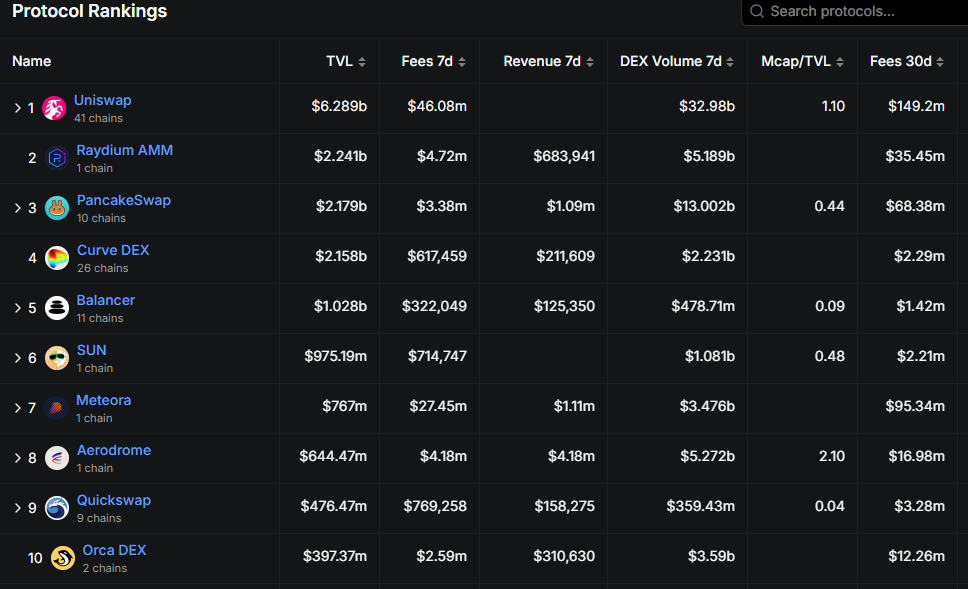
Decentralized exchanges have evolved from simple trading platforms to full DeFi services ecosystem in the recent years. They operate through AMM system, where crypto investors trade directly with liquidity pools (funded by liquidity providers, or LPs) instead of trading with each other. Uniswap first popularized this innovative model in 2018, helping to solve the issue of liquidity in the crypto space.
Moreover, users store their funds in self-custodial wallets, which may or may not be integrated with DEXs. This means users have full control over their private keys when storing funds. These qualities make DEXs more decentralized, as they are not fully managed by a single company. Trades on these platforms are executed by smart contracts deployed by developers.
The decentralized nature of these platforms provides advantages such as self-custody of funds, reduced fees, global accessibility without geographic restrictions, exposure to a wide range of tokens, and innovative financial services like yield farming. However, there are also associated risks, which we discuss in this article.
Decentralized Exchanges Types
1. Automated Market Maker (AMM) DEXs
AMM-based DEXs are the most widely used type of decentralized exchanges. Instead of matching buyers and sellers directly, they rely on liquidity pools funded by users called liquidity providers (LPs). Prices are determined by mathematical formulas based on the ratio of assets in the pool.
AMMs allow continuous trading without needing a counterparty, but they can suffer from slippage and impermanent loss during volatile market conditions.
2. Order Book DEXs
Order book DEXs work similarly to traditional centralized exchanges. Traders place buy and sell orders, and trades are executed when matching orders are found. These systems can operate fully on-chain or use a hybrid model where order matching happens off-chain and trade settlement occurs on-chain.
A key example in this category is dYdX, which focuses heavily on perpetual futures trading.
Order book models generally offer better price control and execution precision but may struggle with liquidity fragmentation compared to AMMs.
3. DEX Aggregators
DEX aggregators do not operate liquidity pools themselves. Instead, they scan multiple DEXs and route trades through the most efficient paths to achieve the best possible price and lowest slippage.
A leading example is 1inch, which combines liquidity from multiple decentralized exchanges into a single optimized trade execution system.
Aggregators improve trading efficiency significantly, especially for large orders, by splitting trades across multiple liquidity sources (DEXs)
How Decentralized Exchanges Work and How to Choose the Best DEX
The AMM system relies on liquidity pools funded independently by liquidity providers. These providers deposit their tokens into a pool, which typically consists of a token pair.
- When traders purchase token A, they sell token B, keeping the product of the pool’s token quantities constant.
- The price is determined by the constant product formula x·y = k and is adjusted after each trade.
Larger trades relative to pool size may cause slippage or significant price changes. Smart contracts handle trade execution, update the pool balances, and reward liquidity providers with a portion of the trading fees. This way, liquidity providers are incentivized to keep funding the pool.
Users do not need to register an account or complete KYC on a DEX. Instead, they connect their wallet to the platform to start trading. This also means users are responsible for custody and safety of their assets, and must always choose a secure crypto wallet.
To choose a good DEX, consider factors such as:
- Number of available pools
- Token availability
- Trade volume and trading fees
- Yield farming and staking opportunities
1. Uniswap
✅ Tradable assets: 10,000+ ERC-20 tokens
✅ Liquidity pools: 30,000+
✅ Trading fees: 0.05%–1%
✅ Best for: token swaps & liquidity provision
Uniswap was the first decentralized exchange that introduced the innovative AMM system to simplify trading. Currently, it is the world’s largest DEX with cumulative trade volume surpassing $2 trillion.
You can trade a wide range of ERC-20 tokens and participate as a liquidity provider, benefitting from its user-friendly interface. While Uniswap’s trading fees are relatively low, overall transaction costs can be high during Ethereum network congestion due to gas fees. Also, you should be aware of the possibility of impermanent losses if you want to start liquidity farming on this platform.
UNI token is the native coin of Uniswap ecosystem, allowing users to participate in community-driven governance of Uniswap. Moreover, upgrades from V1 to V3 and the introduction of layer-2 solutions have brought improvements such as increased capital efficiency, concentrated liquidity, and customizable fee tiers.
2. Pancake Swap
✅ Tradable assets: 3,500+ (multi-chain, mostly BNB Chain)
✅ Liquidity pools: 1,500+
✅ Trading fees: ~0.2%
✅ Best for: yield farming & staking
Built on Binance Smart Chain (now BNB Chain), this platform offers low-cost trading through its AMM system.
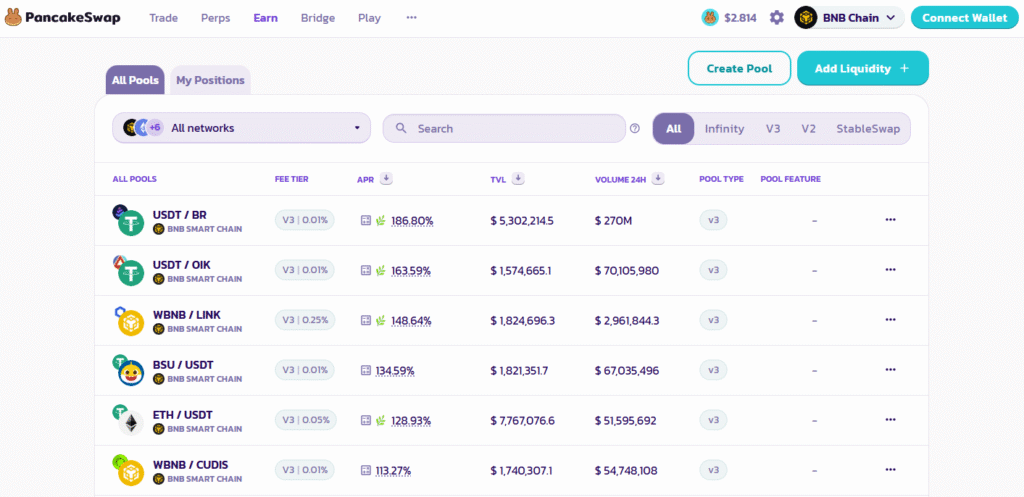
Beyond trading, it also offers other financial services. You can stake crypto, participate in liquidity farming, trade perpetuals, and even buy and sell NFTs. This comprehensive service offering has positioned PancakeSwap as a leading DeFi platform and boosted its popularity in recent years.
CAKE is the native token of PancakeSwap, having versatile utility. You can use this token for staking, yield farming, and participating in governance. Moreover, lower fees, high liquidity, and a user-friendly interface are some of the features that make this platform unique.
3. dydx
✅ Tradable assets: 220+ perpetual markets
✅ Liquidity pools: Order book system (not AMM-based)
✅ Trading fees: 0.05%–0.1%
✅ Best for: perpetual futures trading with leverage
This platform offers spot trading along with advanced financial products such as margin trading and perpetual contracts. These features make the platform particularly attractive to professional traders, especially those who want to trade perpetuals.
What sets dYdX apart is its order book system. In earlier versions, orders were placed off-chain and matched by dYdX Trading Inc. Now in newer system, it is settled on-chain which reduced gas fees and increased trade execution speed. With the launch of dYdX v4, the protocol now operates on its own Cosmos-based blockchain, where the order book and matching engine are run by a decentralized validator network. This design maintains fast trade execution and helps minimize price slippage.
The platform supports a wide range of perpetual markets, and users can also participate in governance through the dYdX token. Overall, dYdX is well-suited for professional traders, though its advanced features may present a learning challenge for crypto beginners.
4. Curve Finance
✅ Tradable assets: Stablecoins & pegged assets (USDC, DAI, USDT, WBTC, etc.)
✅ Liquidity pools: 100+ optimized for stables
✅ Trading fees: 0.01%–0.04%
✅ Best for: stablecoin swaps with ultra-low slippage
It is another DeFi exchange built on Ethereum, that focuses on trading of stablecoins and assets that trade at similar prices like different wrapped BTC versions.
Curve Finance focuses on providing liquidity for stablecoins, so users can trade these coins efficiently with minimal price slippage. Curve’s unique AMM algorithm achieves that by keeping stablecoin trading close to 1-1, like $1 for $1 (even for large trades), by making the pricing formula less sensitive to trade size around that point. This enables stable prices and also incentivizes liquidity providers because the risk of impermanent loss is greatly reduced.
5. 1inch
✅ Tradable assets: Aggregates 389+ liquidity sources across 11 chains
✅ Liquidity pools: Aggregated (not native pools)
✅ Trading fees: Varies per connected DEX
✅ Best for: finding best swap rates & gas optimization
Initially built on the Ethereum blockchain, this platform has since expanded to multiple chains and was designed to make trading efficient by providing best rates and trade paths.
Rather than acting as an exchange itself, it executes trades on various DEXs at the best possible rate and returns the desired crypto to the trader. It is made possible with its Pathfinder algorithm which determines the best possible trade path considering factors like fees and liquidity. A wide range of tokens and coins are available and can be traded without experiencing much slippage. Unique thing about this platform is that it also allows limit orders to specify desired price for traders.
Through the aggregation feature, users can enjoy deep liquidity and best rates for trading.
Comparison of top 5 DEXs
| Decentralized Exchange | Best For | Liquidity Pools | Yield Farm Opportunities |
| Uniswap | Multi-chain token swaps, deep Ethereum + L2 liquidity | Very deep liquidity across ETH mainnet and L2s (Arbitrum, Optimism, Base) | Limited direct farming; LP providers earn trading fees |
| PancakeSwap | Retail trading, low-fee swaps, meme coins, BNB Chain ecosystem | Strong liquidity on BNB Chain with frequent new token listings | Strong yield farming, staking pools, and ongoing incentive programs |
| dYdX | Perpetual futures trading with high leverage and low fees | No traditional AMM liquidity pools; uses order book / liquidity framework for derivatives | No classic yield farming; rewards mainly come from trading activity |
| Curve Finance | Stablecoin swaps, low slippage trading, DeFi liquidity infrastructure | Extremely deep stablecoin liquidity pools (USDC, USDT, DAI, etc.) | Strong yield farming via CRV incentives and gauge-based rewards |
| 1inch | Best-price routing across multiple DEXs, optimized swap execution | Aggregates liquidity from other DEXs | No direct yield farming |
The Downsides of Decentralized Trading
In decentralized exchanges (DEXs), some inefficiencies can also arise. Liquidity shortages, price slippage, and front-running are common problems that reduce the overall user experience and may discourage traders. To address these challenges, many DEXs use concentrated liquidity and liquidity incentives to attract liquidity participation and to improve market depth.
1. Liquidity Issues
Although most DEXs use Automated Market Maker (AMM) systems to enable continuous trading, liquidity can still be limited in smaller pools. This is because AMMs rely on the amount of liquidity providers depositing assets and the trading demand for specific crypto pairs. If there are fewer participants or low trading activity, liquidity depth decreases, leading to poor execution for larger trades. By contrast, large DEXs such as PancakeSwap and Uniswap maintain high trading volumes and deep liquidity, driven by their strong user bases and large pools of participants.
2. Price Slippage
Price slippage is the difference between the expected price of a trade and the actual price at which it is executed. It occurs when a trade is large relative to the pool’s liquidity, or when the pool itself has shallow liquidity. For example, if a trader wants to sell a large amount of tokens in a small pool, their own transaction shifts the token ratio significantly, causing a less favorable price. Slippage can affect both buyers (paying more than expected) and sellers (receiving less than expected).
3. Poor User Experience
Compared to centralized exchanges, many DEXs have more complex user interfaces. Traders often need to perform additional steps such as connecting wallets, approving token spending, setting slippage tolerance, and confirming multiple transactions. For new users, this can feel complicated and less user-friendly. While newer DEXs and aggregators are working to streamline the process, usability remains a challenge for many decentralized platforms.
4. Front Running
Front running is a practice where a trader (or more commonly, an automated bot) takes advantage of knowing that a large transaction is about to occur. On DEXs, this often happens through MEV (Maximal Extractable Value), where bots monitor the public mempool, detect large pending orders, and insert their own transactions before them. For example, before a trader is going to buy a large amount, the frontrunner bot buys crypto and sells it after the large trade of another trader is executed, profiting from the price movement caused by the original trade. Although not illegal in blockchain systems (since all pending transactions are public), it is considered an unfair practice that negatively affects regular crypto traders.
How DEXs Fix Core Trading Inefficiencies
Earlier DEXs design did reveal structural weaknesses such as slippage, and poor liquidity execution quality. Newer generations of DEXs are no longer just “trade platforms.” They are evolving into programmable liquidity systems powered by advanced AMMs, aggregation layers, and MEV-resistant architectures.
1. Concentrated Liquidity
Recently, DEXs introduced concentrated liquidity models where Liquidity providers can allocate the capital to specific price range where trading actually happens. Means, capital does not go to price ranges where trading does not happen.
In older liquidity pool models, capital was allocated with no specific price range, uniform across entire price curve (0 to infinity). But trading only occured in narrow price range (USDT/ETH at $1800 – 2200) while some capital is sitting in extreme range like ETH at $800 or $8000, is idle and never used. Hence, low trading fees generated as not all capital goes to trade execution.
Through concentrated liquidity, deeper liquidity provided in price range where trading is actually happening, and more trade fees is generated.
2. Reducing Price Slippage
Price slippage is now being fixed not just at the pool level—but at the routing layer.
Instead of executing a trade in a single liquidity pool, newer systems split trades across multiple venues to find the most efficient price.
Platforms like 1inch are designed specifically for this purpose. They aggregate liquidity across multiple DEXs and automatically route trades through the most efficient combination of pools.
3. Abstracted Trading Layers
User experience remains one of the biggest barriers in DeFi. Earlier decentralized exchange had complex user interface which made trading difficult for beginners.
Traditional DEX workflows require:
- Wallet connection
- Token approval transactions
- Slippage configuration
- Gas fee management
- Manual transaction signing
To solve this, modern DEXs are moving toward UX abstraction layers, where complex blockchain interactions are hidden behind simplified interfaces.
Some improvements include:
- One-click swaps
- Gas abstraction (fee sponsorship or alternative tokens)
- Embedded wallets
- Cross-chain routing in a single interface
Final Thoughts
The important shift in recent years is that DEXs are no longer trying to make everything more decentralized, they are rather working to outperform centralized exchanges in execution quality and usability. Innovations such as concentrated liquidity, liquidity incentives, intent-based routing, and MEV-resistant transaction systems are transforming how decentralized markets function. At the same time, aggregators and advanced AMM designs are improving pricing efficiency and reducing friction for everyday users.
Overall, the trajectory of DEX development shows a clear direction: from basic automated market makers to highly optimized, programmable financial systems.
Related Guides
Crypto and Digital Assets Guides →
Crypto Passive Income Guides →